

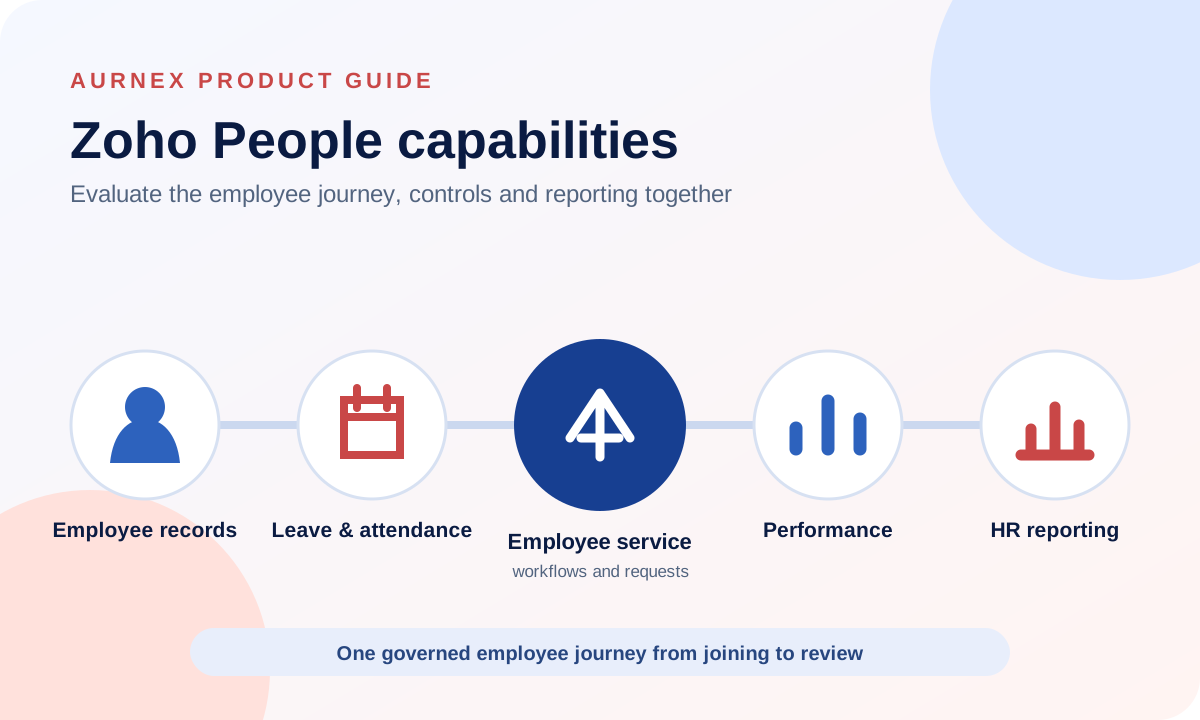
The decision at a glance
Scan the points below, then read the sections relevant to your situation.
Core HR foundation
- Employee records and organisation structure.
- Onboarding, documents and employee self-service.
- Leave policies and approvals.
Workforce processes
- Attendance, shifts and time tracking.
- Timesheets for work or project time.
- HR requests and case handling.
Talent and insight
- Performance and goals.
- Learning where included.
- Reports, analytics and audit history.
Confirm before selection
- Edition and regional availability.
- Privacy, permissions and retention requirements.
- Mobile attendance and location-data policy.
- Zoho People is an HR management system for maintaining employee data and supporting HR workflows.
- The right edition depends on the organisation’s policies, workforce model and required modules.
- Implementation should begin with roles, permissions, policies and data—not a feature count.
01Employee database and organisation structure
Maintain employee profiles and the organisational relationships needed for HR administration. Define the authoritative source, required fields, access rules and ownership before importing employee data.
02Onboarding and offboarding
Structure tasks, forms, documents and responsibilities around joining and exit processes. The workflow should distinguish HR, manager, IT, finance and employee actions.
03Leave and time-off management
Configure leave types, eligibility, accrual, holidays, approvals and balances from the organisation’s documented policy. Test joiners, leavers, carry-forward and exceptional approvals.
04Attendance, shifts and scheduling
Attendance can involve check-in methods, shifts, rosters, regularisation and approval. Mobile or location-based attendance requires a clear employee policy and appropriate permissions.
05Timesheets and work-time approval
Timesheets record time against work, projects or jobs and can support approval and reporting. They should not be described as a replacement for payroll or accounting unless the connected workflow has been separately designed and verified.
06Performance and goals
Performance processes may include goals, key result areas, review cycles and feedback. Configure terminology, participants, evidence and calibration rules from the organisation’s performance policy.
07Employee self-service and mobile access
Employees can access relevant HR tasks from web or supported mobile applications. Decide which profile changes, requests, documents and approvals employees can initiate themselves.
08HR cases and employee requests
Case management can give employees a structured route for HR questions and requests. Define categories, confidentiality, assignment, service expectations and escalation rules before launch.
09Reports, analytics and audit history
HR reporting depends on maintained employee, attendance, leave, performance and workflow data. Begin with specific management questions and restrict sensitive reports by role.
10Integrations, APIs and workflow extension
Zoho People can participate in wider identity, recruitment, finance, payroll and collaboration processes through supported integrations and APIs. Confirm the exact edition, regional payroll requirement and data ownership for each connection.
11Editions and availability: what to verify
Zoho People capabilities and limits vary by edition, country and connected services. Confirm the current regional product information and select an edition only after documenting user roles, required workflows, integrations and reporting needs.
12How should security be evaluated?
A responsible answer is not simply “yes, it is safe.” Review Zoho’s current security documentation and match the available controls to the organisation’s obligations.
- 01Role, form and field-level access requirements.
- 02Multi-factor authentication and identity controls.
- 03Encryption for data in transit, stored data, documents and selected sensitive fields.
- 04Audit, import and export logs.
- 05Data residency, retention, backup and regulatory requirements.
- 06Policies for mobile attendance, GPS or facial-recognition data where used.
13Selection questions before implementation
- 01Which employee lifecycle processes belong in the first phase?
- 02Which policies are already documented and approved?
- 03Who may view or change each category of employee information?
- 04Which attendance, payroll, identity or recruitment systems must connect?
- 05Which reports and audit evidence are required?
Confirm current editions, availability and product capabilities through Zoho’s official regional pages before implementation.
VerificationSources and product references+
Product statements were checked against these official Zoho pages. Availability can vary by region, edition and configuration.
Which HR processes should Zoho People simplify first?
- ?Which employee records and HR processes should move into Zoho People first?
- ?Do leave, attendance and approval policies vary across teams or locations?
- ?Which employees, managers and HR administrators need different access?
- ?Are integrations with recruitment, payroll, finance or identity systems required?
- ?Which features are available in the selected Zoho People plan and country?
If the policies, roles or rollout priorities are still being defined, Aurnex can help map the HR workflow and confirm the appropriate Zoho People scope.
Book a consultation